17 marca 2026AI

At the turn of the 19th and 20th centuries, a technological revolution took place. Machines appeared that automated production. The market built on craft guilds and manufactories collapsed. Specialists who had devoted their entire lives to their professions became unemployed and were forced to work in factories, where as mere appendages to machines they received starvation wages that barely allowed them to survive the month. There was no question of starting a family, saving money, nor was there any way out. From history, we know these people as the proletariat. They were not peasants, they were not slaves, they were not stupid, lazy, or unskilled people. They were people whose fishing rod — one they had made themselves — was taken away, and they were given fish bones in return.


They became a social problem that was politically exploited. From the need to level the disparity between the bourgeoisie, who were growing rich at an unprecedented pace, and the proletariat, who were expanding just as rapidly, socialism and its many variants were born. One of these, supported by communists, was proletarian socialism. The communists openly called the proletariat to revolution, which brought Europe what was probably the greatest bloodshed in history, and plunged its eastern part into decades of darkness.


I know I'm simplifying, and the whole story cannot be told in two paragraphs. But I want to tell it in a way that draws attention to familiar themes. Ultimately, machines brought many benefits to the world, and we would rather not have stopped at the stage of manufactories and guilds. But did so much suffering have to happen along the way?


I believe it was not technology that led to this, but human greed and the lack of an appropriate culture developed in time. On the surface, everything looked fine. The bourgeoisie were people who, at the right moment, saw the coming changes and invested. But culture was lacking. Feudal lords oppressed their subjects, but not to the degree that stripped them of their humanity. Over centuries they learned their relations to the peasants, which was unfair but deep. The bourgeoisie never developed any relation to proletariat, so they saw them no more than a tool to generate wealth. The bourgeoisie saw the problem they had created, everyone saw the problem, but not everyone responded, and those who did acted in their own interest. Ultimately, the proletariat itself also responded in its own interest.


Contrary to appearances, the conclusion is easy to see, though difficult to realize. We have forgotten about the human being. We no longer see them. We celebrate that the wonderful AI technology can do what many specialists do. So we lay off the specialists and reduce the rest to operating AI. We therefore need cheaper, less educated people. Today, like never before. In times when progress matters more than those it is meant to serve.
-
15 marca 2026AI, IT

A Parable of the Violinist

Once upon a time there was a violinist whose passion was, as one might easily guess, playing the violin. Not only did he have talent, but he had mastered his skills for years. Everyone was enchanted by the music he created, and he wanted to do nothing else.

Even when I'm old and they send me off to retirement, I'll keep playing - he used to say. He was offered various promotions — he could have become a conductor, a director of the philharmonic — but he turned down every offer except those that involved playing his instrument. And so he always played first violin and was perfectly suited for the role. When asked where he saw himself in ten years, he would reply that he already had everything he wanted and was doing what he wanted to do; the only thing he dreamed of was doing it better.

At some point, a trend emerged for recording and reproducing music. The market was flooded with people who mixed other people's work, calling themselves artists and even violinists, though they rarely held an instrument in their hands. They created beautiful pieces, drawing among other things on the music of our violinist, whom fewer and fewer people wanted to listen to, as they indulged in the works of those who, despite lacking the ability to play any instrument, called themselves specialists — just of a different kind.

Nowadays it doesn't matter whether you play the violin or the piano; what counts are skills of a different sort - they would say, pointing their finger at the violinist - those who failed to evolve get left behind and have only themselves to blame. This is where laziness and lack of ambition lead. After some time, the violinist put away his instrument, because no one wanted to listen to his works anymore. People still listened to music, of course, but only to what was replayed and remixed from what the old musicians had created. Our hero decided to start mixing himself. He did it well, because he loved music and understood it far better than the self-taught vibe-musicians. Nevertheless, he never touched the violin again.

However, this story was not about a violinist, and not about a music.

-
8 marca 2026AI, IT

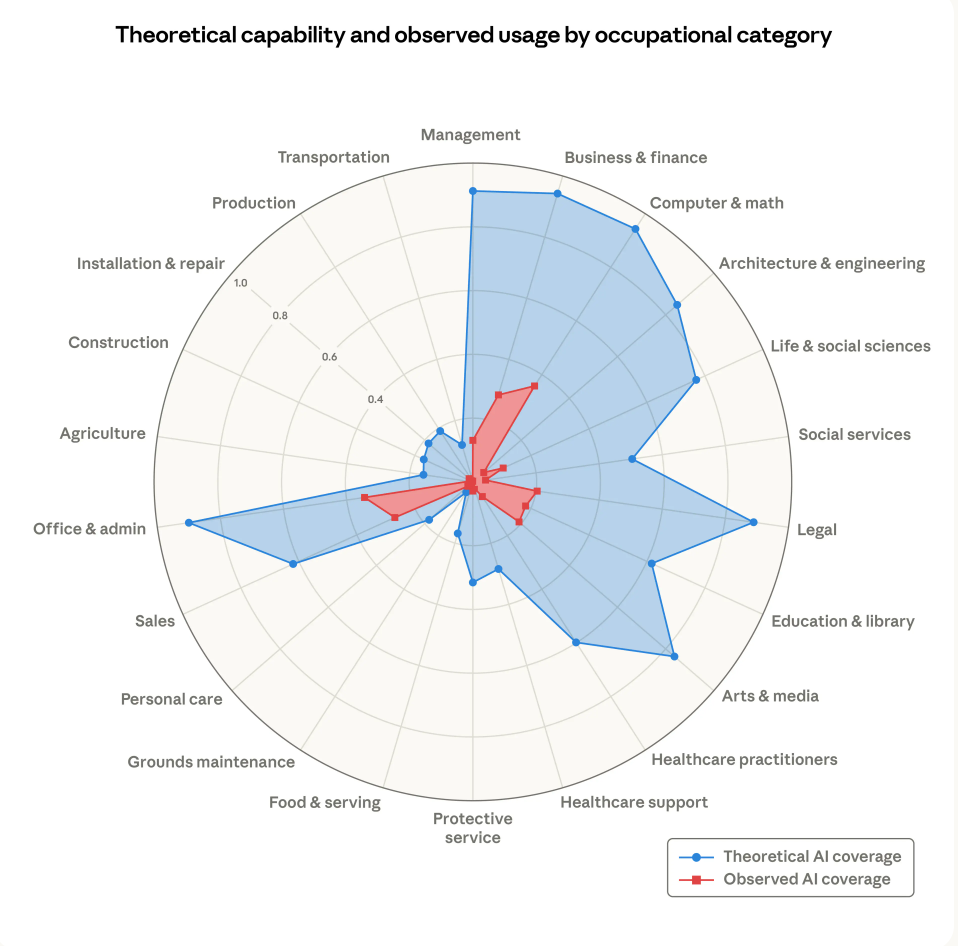
I came across this comparison on LinkedIn. With a comment that AI inferred from the O*NET database and millions of real usage sessions that for programmers, about 75% of typical tasks are classified as automatable. For obvious reasons, this is a signal for many that the twilight of the IT aristocracy is coming and programmers should start packing their bags.

It's worth to mention that the diagram comes form Anthropic Research – Labor market impacts of AI / AI Exposure Index (March 2026), Anthropic Economic Index (January 2026 and September 2025) and keeping in mind the inherent conflict of interest.

I remain skeptical about this type of analysis, though. First and foremost, percentages mislead most people who deal with percentages. The problem with charts is that they're easy to interpret in favor of a thesis everyone already expects, so few bother to question it. For me, there are two key questions here:

What will this look like in absolute terms?

The natural reaction is a sense of threat that since AI is supposed to handle 75% of tasks, we won't need 75% of the programmers currently on the market. On top of that, other statistics say that companies already don't want to hire juniors. Combining the right data points, it's easy to conclude that IT is heading for an apocalypse. But if a single project used to require a team of thirty people and today only three are enough, then instead of firing twenty-seven, you can take on nine additional projects. You'd still have thirty people employed, and instead of one project you'd be doing ten, delegating most tasks to AI, and the equation saying AI will handle 75% of tasks still holds. We haven't pushed specialists out of the market — we've expanded the market. Why isn't this happening? I think it's due to a transitional period and mounting crises around the world. Companies are going into emergency mode and not investing in growth. Laid-off programmers won't vanish into thin air — they'll have to do something, and that something will most likely be a surge of new companies that are far more agile than the old ones and will leverage AI from day one. It may turn out in the end that even though AI handles most tasks for us, the demand for specialists will increase, not decrease. Right now we're in a crisis, and it shows everywhere. But before prophesying AI-driven threats and backing them with data, let's end the wars we're fighting, lower interest rates, let companies invest, and see what happens then — whether AI is more of a danger or an opportunity.

Why AI is entering these professions and not others?

The quick answer here is that these professions are the easiest to replace. I beg to differ. It really doesn't take much for AI to enter anything. Just as in IT it uses agents and programs already installed on computers to perform tasks, along with various connectors, AI can post job listings and use people where it can't do something itself. Apparently, there are already ideas for AI to pay subcontractors for work. I personally argue that AI is replacing tasks in IT fastest not because of ease, but because of the environment. People in IT are the most active AI users, and the market is large. I myself stopped doing many of my tasks by delegating them to Claude, because there's no point in me spending hours on something I could do in a few minutes. People in IT are the most susceptible to AI because they see its potential and want to use it. As a programmer, I use Claude, which lets me do ten things in the time I used to do one. My manager or the company CEO doesn't do this. AI helps me in my work and it's me who delegates tasks while doing my own job. At the end of the day, I still sign off on everything. IT is the biggest beneficiary of AI, because it was IT that created AI, and IT understands its potential and wants to leverage it.

Is anyone actually at risk? Let's not kid ourselves — IT is no longer an El Dorado for anyone who can launch an IDE and write a few lines of code, or fix bugs someone else introduced while building a feature. Even seniors with years of experience or more capable juniors won't be doing the things they used to do. Just as a farmer no longer goes out to the field with a scythe for weeks on end, but heads out for a day or two with heavy equipment. He's still a farmer — only his tools have changed, and his work is more efficient. And that's a good thing, because there are more and more people who need to eat. The demand for farmers hasn't declined that drastically. I think the same will happen with programmers. We'll create differently than before, and better. Focusing on the task at hand instead of getting bogged down in frameworks for frameworks and libraries for libraries.

-

Welcome, adventurer. My name is Maciej Puczkowski and I hope you will find here plenty of thought-provoking topics, challenging you to disagree. Initially, this was meant to be a technical blog supporting my professional career. Although by profession and education I am a Software Developer, my inner scientist has turned me into a modern Renaissance man. A hunger for knowledge led me to independently study many fields, and today, quoting Zarathustra: "Here I am, surfeited with my wisdom, like a bee that has gathered too much honey." I would like to share a synthesis of my reflections. You will find here content related to both programming and working in IT in general, as well as life itself. This is also meant to be a space for my own growth and experimentation with various forms and thoughts, many of which may be unpopular. If you stick around, even if only to argue, I will be very pleased.

-

You've reached the end